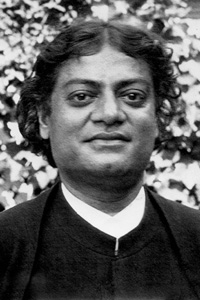
Swami Vivekananda:-
 (January 12, 1863 – July 4, 1902),
whose pre-monastic name was Narendranath Dutta, was one of the most famous and influential spiritual leaders of the philosophies of Vedanta and Yoga. He was the the most eminent disciple of Ramakrishna Paramahamsa and the founder of Ramakrishna Math and Ramakrishna Mission. He is a major figure in the history of the Hindu reform movements.
While he is widely credited with having uplifted his own nation, India, he simultaneously introduced Yoga and Vedanta to America and England with his seminal lectures and private discourses on Vedanta philosophy. Vivekananda was the first known Hindu Sage to travel to the West, where he introduced Eastern thought at the World's Parliament of Religions, in connection with the World's Fair in Chicago, in 1893. Here, his first lecture, which started with the opening line "Sisters and Brothers of America," made the audience clap for two minutes in appreciation, for prior to this seminal speech, they were always used to the usual address of "Ladies and Gentlemen". It was this speech that catapulted him to fame by his wide audiences in Chicago and then later everywhere else in America, including far-flung places such as Memphis, Boston, San Francisco, New York, Los Angeles, and St. Louis.
Birth and early life Narendranath Dutta was born in Shimla Pally, Kolkata, India on January 12, 1863 as the son of Viswanath Dutta and Bhuvaneswari Devi. Even as he was young, he showed a precocious mind and keen memory. He practiced meditation from a very early age. While at school, he was recognized early on as an academic genius, and showed excellence in games of various kinds. He organized an amateur theatrical company and a gymnasium and took lessons in fencing, wrestling, rowing and other sports. He also studied instrumental and vocal music. Even when he was young, he questioned the validity of superstitious customs and discrimination based on caste and religion.

In 1879, Narendra entered the Presidency College, Calcutta for higher studies. After one year, he joined the Scottish Church College, Calcutta and studied philosophy. During the course, he studied western logic, western philosophy and history of European nations.
Questions started to arise in young Narendra's mind about God and the presence of God. This made him associate with the Brahmo Samaj, an important religious movement of the time, led by Keshub Chunder Sen. And along with his classmate and friend Brajendra Nath Seal, he regularly attended meetings of the breakaway Sadharan Brahmo Samaj. Later they would part ways with Dutta aligning himself with Keshub Chunder Sen's Nava Vidhan and Seal staying on as an initiated member. During this time spent together, both Dutta and Seal sought to understand the intricacies of faith, progress and spiritual insight into the works of John Stuart Mill, Auguste Comte, Herbert Spencer and G.W.F. Hegel.

But the Samaj's congregational prayers and devotional songs could not satisfy Narendra's zeal to realize God. He would ask leaders of Brahmo Samaj whether they have seen God. Their answers did not satisfy his quest for knowledge. It was during this time that Reverend William Hastie, the Principal of the Scottish Church College told him about Sri Ramakrishna of Dakshineswar.
REFORMER FOR THE REFORMER:- 
Narendra met Ramakrishna for the first time in November 1881. He asked Ramakrishna the same question he had so often asked of others, "Mahashaya (Venerable Sir), have you seen god?" The instantaneous answer from Ramakrishna was, "Yes, I see God, just as I see you here, only in a much intenser sense. God can be realized," he went on, "one can see and talk to Him as I am seeing and talking to you. But who cares? People shed torrents of tears for their wife and children, for wealth or property, but who does so for the sake of God? If one weeps sincerely for Him, he surely manifests Himself." Narendra was astounded and puzzled. He could feel the man's words were honest and uttered from a deep experience. He started visiting Ramakrishna frequently. At first he did not believe that such a plain man could have seen God, but gradually he started having faith in what Ramkrishna said.
Though Narendra could not accept Ramakrishna and his visions, he could not neglect him. It had always been in Narendra's nature to test something thoroughly before he could accept it. He tested Ramakrishna to the maximum, but the master was patient, forgiving, humorous, and full of love. He never asked Narendra to abandon reason, and he faced all of Narendra's arguments and examinations with patience. In time, Narendra accepted Ramakrishna, and when he accepted, his acceptance was whole-hearted. While Ramakrishna predominantly taught duality and Bhakti to his other disciples, he taught Narendra the Advaita Vedanta, the philosophy of non-dualism.

During the course of five years of his training under Ramakrishna, Narendra was transformed from a restless, puzzled, impatient youth to a mature man who was ready to renounce everything for the sake of God-realization. In August 1886, Ramakrishna's end came in the form of throat cancer. After this Narendra and a core group of Ramakrishna's disciples took vows to become monks and renounce everything, and started living in a supposedly haunted house in Baranagore. They took alms to satisfy their hunger and their other needs were taken care of by Ramakrishna's richer householder disciples.
Soon, the young monk of Baranagore wanted to live the life of a wandering monk with rags and a begging bowl and no other possessions. On July 1890, Vivekananda set out for a long journey, without knowing where the journey would take him. The journey that followed took him to the length and breadth of the Indian subcontinent. During these days, Vivekananda assumed various names like Vividishananda (in Sanskrit, Vividisha means "the desire to know" and Ananda means "bliss"), Satchidananda, etc. It is said that the Maharaja of Khetri, Ajit Singh, suggested to him the name Vivekananda because of his discernment of things, good and bad. Viveka or discrimination between the eternal and the transient was highly valued by the Swami, who, recollecting that Keshab Chandra Sen used to call him by that name, accepted it.

During these wandering days, Vivekananda stayed in kings' palaces, as well as the huts of the poor. He came in close contact with the culture of different regions of India and various classes of people in India. Vivekananda observed the imbalance in society and tyranny in the name of caste. He realized the need for a national rejuvenation if India was to survive at all. He reached Kanyakumari, the southernmost tip of the Indian subcontinent on 24 December 1892. There, he swam across the sea and started meditating on a lone rock. He thus meditated for three days and said later that he meditated about the past, present and future of India. The rock went on to become the Vivekananda memorial at Kanyakumari.
Vivekananda went to Madras and spoke about his plans for India and Hinduism to the young men of Madras. They were impressed by the monk and urged him to go to the United States and represent Hinduism in the World Parliament of Religions. The Raja of Ramnad, who was originally invited for the conference, promoted Vivekananda as the right person to represent the views of Hinduism in the Parliament. Thus, helped by his friends at Chennai, Bhaskara Sethupathi, Raja of Ramnad and Maharajas of Mysore and Khetri, Vivekananda set out on his journey to the USA.
END OF THE MYTHELOGICAL JOURNEY OF The Saviour Of HINDUISM
On July 4, 1902 at Belur Math near Calcutta, he taught Vedanta philosophy to some pupils in the morning. He had a walk with Swami Premananda, a brother-disciple, and gave him instructions concerning the future of the Ramakrishna Math. He passed away in the evening after a session of prayer at Belur Math. He was 39. Doctors pronounced that the death was due to apoplexy, but the monks were convinced that he had attained mahasamadhi, as Sri Ramakrishna had predicted. Vivekananda had fulfilled his own prophecy of not living to be forty-years old.